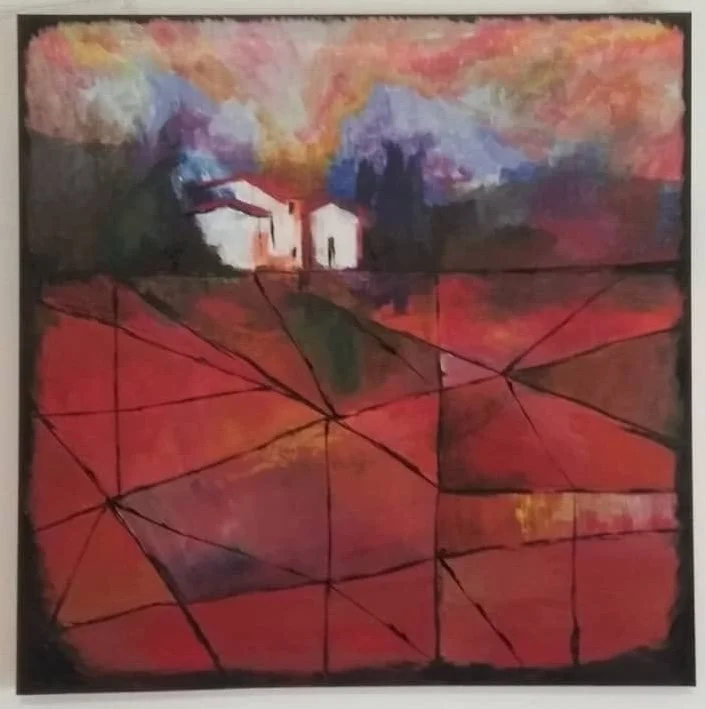
“Take Me“
2019
Acrylic on canvas
Where does my work come from?
My work is deeply rooted in emotion and in the experiences of everyday life. Thoughts, desires, love, uncertainty, change and moments of both tension and happiness all find their way into my paintings. Art has become a way of giving a visible form to things that are often difficult to express through words.
I graduated in Fine Arts in Salamanca, Spain, in 2018, where I developed a multidisciplinary artistic foundation and explored different ways of working with image, material and visual language.
A year later, I moved to London. I remember that time as one of the most difficult, yet also one of the most beautiful periods of my life. I arrived without speaking English and began working in cafés, earning barely enough to cover the cost of renting a room. It was a period of survival, uncertainty and profound personal change.
One day, on my way to work, I found a canvas outside my house. It was a printed image of a house, with a small piece of paper attached to it that simply said: “Take me.” I took it home, picked up the paints I had brought with me from Spain, and began painting over it.
Something happened that day. For the first time, I felt that my body was asking me to let go. I began layering colours and gestures without knowing where the painting was going. Slowly, the feelings I was experiencing began to take shape on the canvas.
That moment became the beginning of my relationship with abstract painting.
Today, I continue to paint from that same place of intuition. I don't always know what a painting will become when I begin. I allow colour, gesture and movement to respond to how I feel, creating a constant dialogue between myself and the canvas.
My paintings are not intended to explain a particular emotion, but to make space for one. Each work carries something of my own experience, but once it leaves my hands, it belongs to the person looking at it.
I am interested in that moment of connection — when someone stands in front of a painting and feels something before they have the words to explain what it is.
I paint what I cannot put into words.
FAQs
-
My work comes from my own life. Art touches every kind of emotion and experience that I go through: thoughts, desires, love, moments of tension, happiness, change, and everything that, in one way or another, leaves a mark on me. Painting is my way of making visible what I often cannot express through words.
I began painting abstractly in 2019, when I moved to London. I remember that period as one of the most difficult and, at the same time, most beautiful moments of my life. It may sound contradictory, but for me, both things existed together.
I arrived without knowing how to speak English and started working in cafés, earning a salary that barely covered the cost of renting a room. Those were months of survival, uncertainty and profound internal change. I was going through a very deep personal transformation and, although I didn't know how to put it into words at the time, I could feel something inside me changing.
One day, on my way to work, I found a canvas outside my house. It was a printed image of a house on canvas. I picked it up, took it home and grabbed the paints I had brought with me from Spain. I decided to paint over the image.
That was the first time I felt that my body was asking me to simply let go. I began layering colours, gestures and marks, and gradually, the feelings I was experiencing at that moment began to come alive on the canvas.
From then on, painting became a way of recording my life in a transparent and visceral way.
-
Gesture is a form of language. It is what happens before reason takes over, when I allow my body to respond directly to what I am feeling.
Every movement, brushstroke and mark carries an emotional weight. Sometimes the gesture is fast and almost violent; at other times it is slower and more delicate. I don't want every movement to be beautiful. I want it to be honest.
-
Colour has always had a very important place in my life. It gives me energy, and it is one of the ways we reveal something of ourselves, even without realising it. We express ourselves through colour every day — even in the way we dress. When we are feeling low, we often gravitate towards darker tones; when we feel happy or full of energy, we naturally reach for brighter, more joyful colours.
The same thing happens when I paint. My choice of colour is instinctive and closely connected to my emotional state. I don't always consciously decide which colours I am going to use. They often emerge from how I am feeling in that particular moment, almost as if the canvas knows before I do.
For me, colour carries emotion. It can change the atmosphere of a painting, create tension, bring calm, or give a sense of movement and life.
There are, however, two colours that have become particularly significant within my work: carmine and turquoise. I return to them again and again, almost instinctively. Over time, they have become part of my visual identity — two colours that, in a way, feel like a reflection of me.
-
I don't paint with the intention of pleasing the viewer, or of being recognised as a “good” painter. What matters to me is the emotion that the work can transmit.
I find it fascinating that a painting which, to me, clearly carries a particular feeling can evoke something completely opposite in someone else. The same colours, gestures and marks can hold entirely different meanings depending on the person looking at them.
For me, that is one of the most beautiful things about abstract art. I don't want to tell the viewer what they should feel or see. I want the work to leave space for their own emotions, memories and experiences to enter into it.
Ultimately, I don't need the viewer to like my work. What matters to me is that it gives them something — a feeling, a thought, a memory, a moment of connection — even if that feeling is completely different from the one I had when I painted it.
-
At university, one of my professors told me something I have never forgotten: all artists belong to a family of artists.
He explained it through Cézanne. Imagine never having seen his paintings, never having studied his work, and not even knowing who he was. Yet your palette, your brushstrokes and the way you see the world through art naturally move in a similar direction. Perhaps that means Cézanne belongs to your artistic family.
I find this idea beautiful because I don't think our artistic family is necessarily made up of the artists we consciously choose to admire. Sometimes we recognise a connection before we even understand where it comes from.
It can be found in the way we use colour, in the rhythm of a brushstroke, in the way we respond to light, movement or emotion. It is something instinctive — a shared way of seeing and translating the world.
I think of my own practice in this way. I am constantly discovering artists who feel strangely familiar to me, as if we speak the same visual language despite having lived completely different lives.
Perhaps our artistic family is made up of those artists whose work makes us think, “I understand this. I don't know why, but I understand it.
-
In May 2024, I opened my own tattoo studio. But for me, it was always more than a place to tattoo. I wanted it to be a small space for art too, so I created a little corner where I could paint.
Until then, painting had always been something very private. It was a space where I could be alone with myself, without thinking about how anyone else might see what I was doing. So, at first, I felt a little embarrassed painting in front of people. I wasn't used to anyone watching the process, seeing an unfinished painting, or witnessing those moments when I wasn't sure where the work was going.
But something unexpected happened.
People began to stop and look. They would ask me about the paintings, tell me what they saw in them, compliment them, or sometimes simply say, “I don't understand it, but I like it.”
That sentence stayed with me.
I found it fascinating that a painting could create a connection without necessarily being understood. What I had felt so clearly while making it could become something completely different in someone else's eyes.
Over time, I stopped feeling self-conscious about painting in front of people. I began to enjoy the fact that the paintings were being created in a shared space, surrounded by conversations, questions and different ways of seeing.
In a way, the people around me became part of the process without ever touching the canvas.
What begins as something deeply personal now has a public life of its own. And I think that is one of the things I value most about painting: I can decide where the work begins, but I cannot decide where it ends.
-
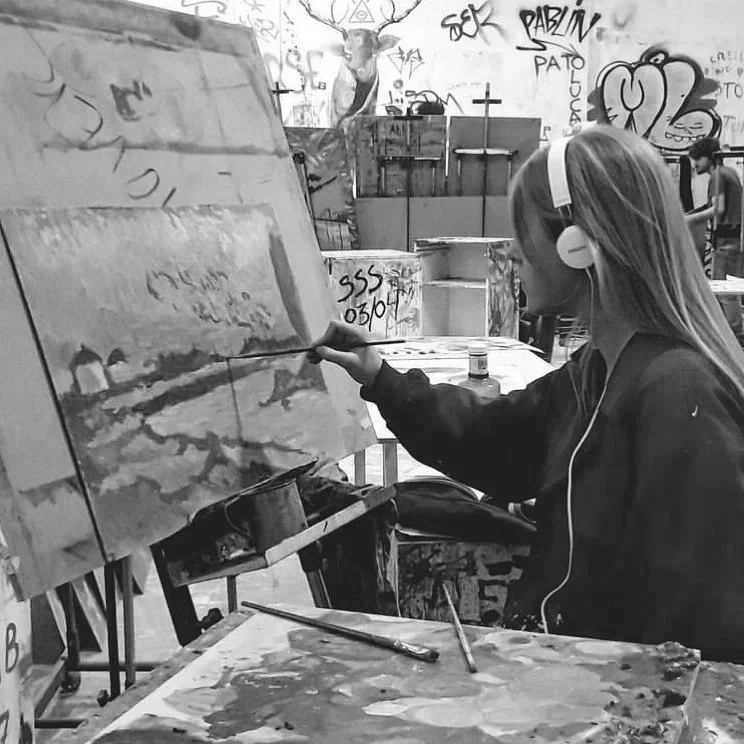
I am a Spanish multidisciplinary artist based in London. My artistic education began with an Arts Baccalaureate in Spain, followed by three years of study in Sculpture and four years of Fine Arts at the University of Salamanca, where I specialised in painting and landscape. I graduated in 2018.
In 2019, shortly after moving to London, I began developing my abstract painting practice. This period of my life became a significant turning point, both personally and artistically. Living in a new country, learning a new language and experiencing a period of profound change led me to discover painting as a way of expressing emotions and experiences that I could not always put into words.
My practice is rooted in emotion, instinct and personal experience. Through colour, gesture and layered compositions, I explore inner states and the relationship between what is felt and what can be expressed visually. Although my work is abstract, it begins with something deeply personal: a thought, a feeling, a memory or a moment in my life.
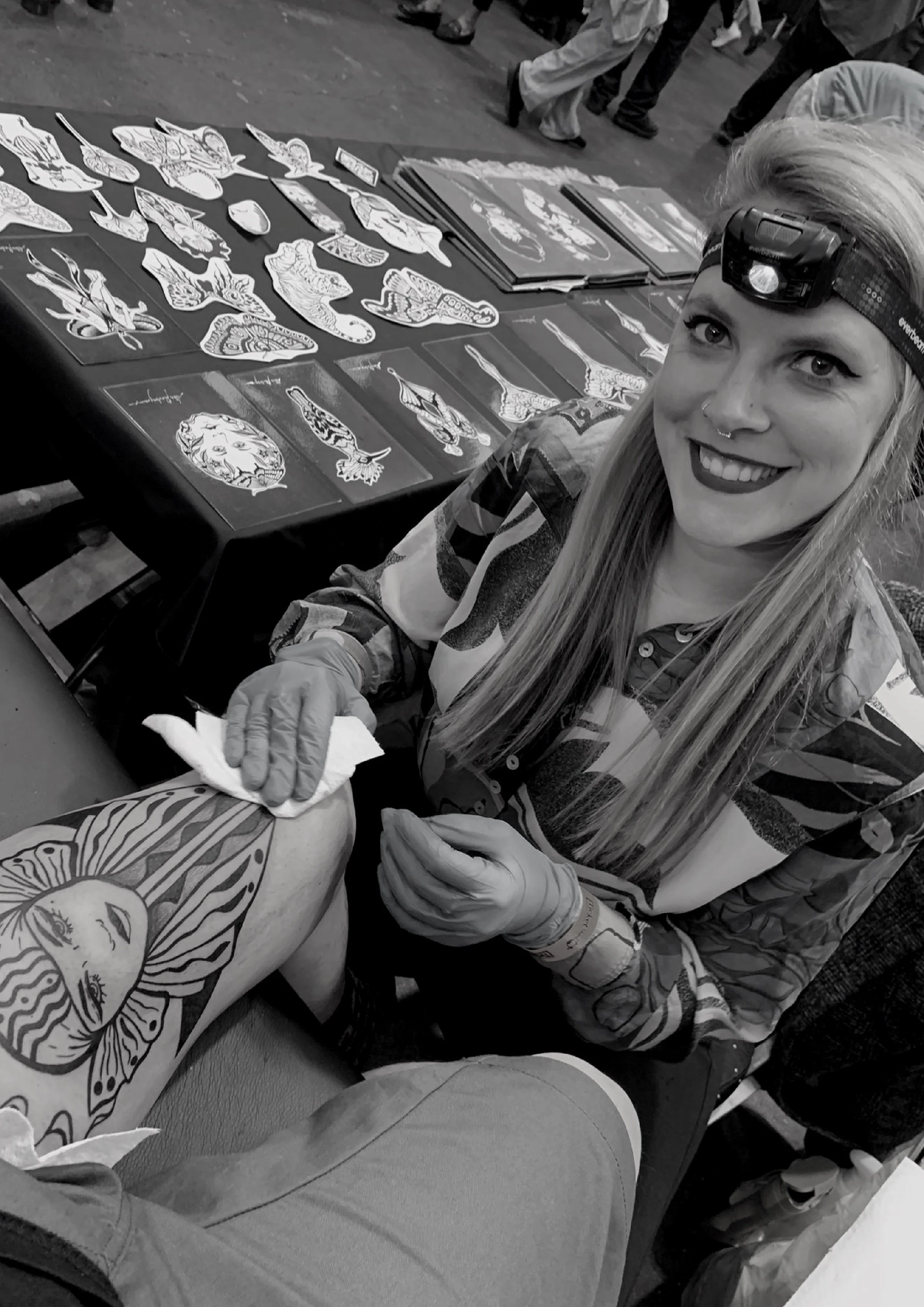
Alongside painting, I work as a tattoo artist. I see tattooing as another form of visual expression — one that allows me to work directly with the body and create something permanent and deeply personal. In May 2024, I opened The Nana Room in London, a creative space where my tattoo practice exists alongside my work as an artist. Within the studio, I created a small dedicated space where I could continue painting.
Today, my practice moves between painting, tattooing and other forms of visual expression. Although each medium offers a different way of working, emotion remains at the centre of everything I create.
I am interested in the space between intuition and control, between the personal experience of making a work and the completely different experience it can create for someone looking at it. For me, a painting does not need to be understood in order to create a connection. It simply needs to leave something behind.